


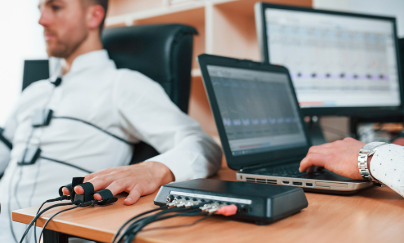
Most people picture a polygraph test as that tense movie scene: someone sweating in a chair, wires attached, an examiner staring them down while a machine spits out jagged lines. One wrong answer and—bam—you’re caught.
That’s the myth.
The reality is a lot quieter, a lot messier, and honestly, a bit more controversial than people expect. A polygraph test isn’t a lie detector in the clean, sci-fi sense. It doesn’t read your mind. It doesn’t know the truth. What it does is measure your body reacting under pressure—and then someone interprets those reactions.
And that gap between reaction and truth? That’s where things get interesting.
So What Is a Polygraph Actually Measuring?
At its core, a polygraph records physical responses. Heart rate, blood pressure, breathing patterns, and skin conductivity—basically, how your body behaves when you’re asked certain questions.
The idea is simple enough: when people lie, they get nervous. That nervousness shows up in the body. The machine records it. The examiner analyzes it.
But here’s the thing—your body doesn’t only react to lying.
It reacts to fear. Stress. Embarrassment. Anger. Even confusion.
Imagine sitting in a chair, hooked up to sensors, being asked something serious like, “Did you take the missing money?” Even if you’re completely innocent, your body might spike just because the situation is intense. Your brain knows what’s at stake.
Now flip it. Someone who’s practiced staying calm, or doesn’t feel guilt the same way, might show very little reaction while lying.
That’s the central tension of polygraph testing. It measures arousal, not deception.
How the Test Usually Works
If you’ve never seen one up close, the process is more structured than people expect.
First comes the pre-test phase. This can take a while. The examiner talks through the questions, explains the process, and often tries to establish a baseline. You’ll be asked general questions like your name or whether you’ve ever lied in your life—things designed to get predictable responses.
Then comes the actual test. Questions are asked in a specific sequence, usually mixing relevant questions (about the issue at hand) with control questions (broader, emotionally loaded ones).
For example:
- “Did you steal the laptop?”
- “Have you ever lied to get out of trouble?”
The idea is to compare how your body reacts to each type. If your reaction to the relevant question is stronger, it may suggest deception. If the control questions trigger bigger responses, you might be considered truthful.
Sounds neat on paper.
In practice, it’s not always so clean.
Why People Believe in It
Despite the criticism, polygraph tests haven’t disappeared. Law enforcement still uses them. Certain government roles require them. Private employers sometimes rely on them in specific situations.
Why?
Partly because they can be useful—not as a truth machine, but as a psychological tool.
When someone believes the test will expose them, they may confess before or during the process. That alone can make the test valuable to investigators.
There’s also something about being watched and measured that changes behavior. People feel pressure. They second-guess themselves. They talk more than they planned to.
In that sense, the polygraph isn’t just measuring you—it’s influencing you.
Where It Gets Complicated
Here’s where things start to wobble.
Polygraph accuracy is debated. Some studies suggest relatively high accuracy under controlled conditions. Others show significant error rates, especially in real-world scenarios.
False positives happen. That’s when truthful people are flagged as deceptive.
False negatives happen too. That’s when someone lies but doesn’t trigger strong reactions.
Let’s be honest—both are a problem.
Imagine being denied a job because your body reacted strongly under stress, even though you told the truth. Or imagine someone slipping through despite lying, simply because they stayed calm enough.
That’s why many courts don’t accept polygraph results as reliable evidence. The margin for error isn’t small enough.
Can You Beat a Polygraph?
This question comes up a lot, and the answer isn’t as straightforward as people want.
There’s no magic trick that guarantees you’ll “beat” the test. But it’s also true that the system isn’t foolproof.
Some people try to control their breathing. Others attempt to create artificial stress during control questions—like subtly tensing muscles or doing mental math—to even out their responses.
Does it work?
Sometimes. Sometimes not.
Examiners are trained to look for signs of manipulation. And overdoing it can backfire, making your results look even more suspicious.
More importantly, focusing on “beating” the test can actually increase your stress levels, which shows up in the data anyway.
Ironically, the harder you try to game it, the more reactive you might become.
What It Feels Like to Take One
If you’ve never sat through a polygraph, it’s not physically painful—but it can be mentally draining.
You’re sitting still, hooked up to sensors, knowing every breath and heartbeat is being recorded. The room is usually quiet. The examiner watches closely.
Even small things start to feel amplified.
A pause before answering. A slight shift in your seat. The way your voice sounds when you say “no.”
Now imagine being asked something personal or serious, even if it’s not true. Your brain starts running scenarios. “What if they think I’m lying?” That thought alone can trigger a response.
That’s what makes the experience so intense. It’s not just about truth—it’s about perception.
Real-World Uses (and Misuses)
Polygraphs show up in more places than people realize.
They’re often used in criminal investigations—not always to prove guilt, but to guide questioning. They can influence how investigators proceed, even if the results aren’t officially admissible.
In employment, certain sensitive roles—like intelligence or security—may require polygraph testing. Not everyone agrees with this practice, especially given the accuracy concerns.
There are also cases where polygraphs are used in personal disputes. Think infidelity accusations or family conflicts. That’s where things can get murky fast.
Using a polygraph in personal situations can escalate emotions rather than resolve them. A test result—accurate or not—can deepen mistrust instead of clearing it up.
The Psychology Behind It
Here’s the part that often gets overlooked: the polygraph is as much about psychology as physiology.
The examiner isn’t just reading a machine. They’re observing behavior, listening to tone, watching how you respond before and after questions.
The setup itself creates pressure. You’re placed in a situation where you feel evaluated. That alone changes how you act.
People tend to assume the machine is the authority. But interpretation plays a huge role.
Two examiners might look at the same data and come to different conclusions. That’s not something most people expect when they imagine a “scientific” test.
Should You Trust a Polygraph Result?
Short answer? Be cautious.
A polygraph result can provide clues, but it shouldn’t be treated as absolute truth.
If someone “fails” a test, it doesn’t automatically mean they’re lying. It means their body reacted in a way that raised suspicion under specific conditions.
Context matters. Emotional state matters. Even how the questions are phrased can influence results.
On the flip side, passing a polygraph doesn’t guarantee honesty either.
It’s a tool. Not a verdict.
A Simple Way to Think About It
If you strip away the mystique, a polygraph is basically a stress detector paired with an interpretation process.
That doesn’t make it useless—but it does mean it has limits.
Think of it like reading someone’s body language during a tough conversation. You can pick up signals, but you can’t know exactly what they mean without context.
The machine just scales that idea up and records it.
Final Thoughts
Polygraph tests sit in that uncomfortable space between science and perception. They’re not pure guesswork, but they’re not definitive truth machines either.
They can nudge conversations in the right direction. They can prompt confessions. They can even provide helpful insights in certain situations.
But they can also mislead, especially when people treat them as infallible.
Here’s the takeaway: a polygraph doesn’t tell you whether someone is lying. It tells you how their body reacted when they answered.
And those two things aren’t always the same.
If you keep that distinction in mind, the whole subject starts to make a lot more sense.